“Perhaps these aren’t poetic times at all”
– Nikki Giovanni
FUCK TRUMP
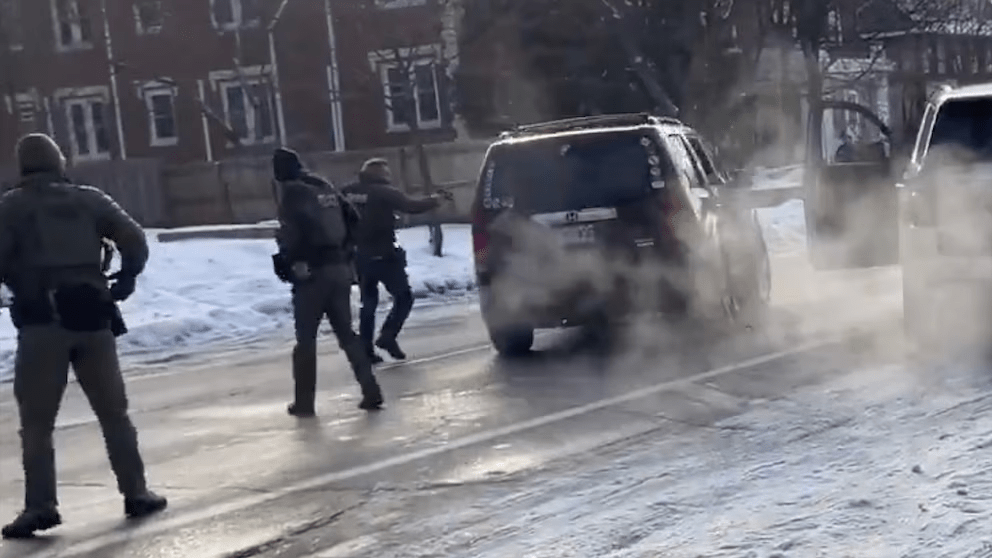
I wanted to write a poem
about Minneapolis.
I wanted to write a poem
about the murder of
Renee Nicole Good,
but I didn’t know
where to start.
NO KINGS
Maybe I should start
on 9 November 1938
when a German diplomat
was assassinated in Paris,
and the assassin happened
to be Jewish.
In response, the SS along
with the SA and members
of the Hitler Youth destroyed
1,400 synagogues
and 7,000 Jewish owned businesses.
Hitler’s government turned a blind eye.
Hitler’s government, in fact,
encouraged it.
In the aftermath,
and I mean within two days
of the pogrom,
within two days of that
Night of Broken Glass,
30,000 Jewish men were rounded up
and sent to camps:
Buchenwald, Dachau, and Sachsenhausen.
The government used this
as an excuse to further the detainment
and murder of the Jewish community
throughout Germany, Austria,
and the Sudetenland.
They used it as an excuse
to seize land and wealth.
FUCK TRUMP
Or maybe I should start
in September of 1948
when the Soviet government
began arresting Jewish activists.
By June of 1949
Thirteen men had been detained.
Thirteen men never to be seen again.
These men, these proud members
of a society that never wanted them,
were falsely accused
of espionage and terrorism.
They sat in prison for three years,
during which they were
beaten, tortured, and raped.
This culminated in August of 1952
with their murders.
On 12 August 1952,
The Night of the Murdered Poets,
all thirteen men were assassinated
in their cells, in Lubyanka Prison.
That prison still stands.
With proper approval,
you can even visit it.
You can tour the cells, the toilets,
the museum.
That prison still stands,
but those thirteen men
fell that night,
never to stand again.
Businessmen, government officials,
politicians, scientists,
and five brave poets
were never to stand again.
ABOLISH ICE
Or maybe I should start
In October of 1968.
Students from across
Mexico City had organized.
Students from across
Mexico City stood up to
the Partido Revolucionario Institucional.
The nationalistic, authoritarian
government, backed by
Lyndon Baines Johnson
and the United States,
moved on the demonstrators.
The nationalistic, authoritarian government,
with American weapons and American funds,
was preparing for the Olympics,
was afraid of the bad press
before the Olympics,
was in need of a quick solution.
That solution came
on 2 October 1968
as the troops entered
Plaza de las Tres Culturas
and opened fire.
Thousands were arrested,
thousands were injured,
and hundreds, with the hearts of poets,
lay dead in the square,
murdered by the US backed
Partido Revolucionario Institucional
to ensure a successful Summer Olympics.
DEMAND JUSTICE
Or maybe I should start
in September of 1973.
That’s when Pablo Neruda
was suffering with prostate cancer.
That’s when Pablo Neruda
was on his deathbed
in a Santiago hospital;
he was nearing the end.
Pinochet couldn’t wait though.
Pinochet needed his death expedited.
On 23 September 1973,
Pinochet tasked a doctor
with the strangest of jobs:
injecting poison into Neruda’s stomach.
Perhaps the most famous poet
ever assassinated
was assassinated by his
authoritarian government.
“Tonight, I can write the saddest lines,” he said.
Tonight, in the wake of Renee Nicole Good,
we can all write the saddest lines.
I’ve read his poems.
I’ve known that the life of a poet
could be dangerous.
Neruda showed us
that the life of a poet
could, in fact, be deadly.
FUCK TRUMP
Or maybe I should start
in June of 1989.
That’s when, after months of protests
following the death of Hu Yaubang,
students gathered in Beijing.
Demanding justice, equality, free elections,
students gathered in Beijing.
A peaceful protest,
labeled a “Counter-Revolutionary Rebellion”
in official government statements,
and soon labeled simply a “riot,”
was broken up by the military.
You see, 300,000 troops from
The People’s Liberation Army
were deployed to Beijing.
300,000 troops to quell the uprising.
By the morning of 4 June 1989
3,000 people, poets to the last,
were dead in Tiananmen Square.
By the morning of 4 June 1989,
3,000 people had been murdered
by a scared government
that knew the winds of change
were blowing.
FUCK ICE
Did you know Renee Nicole Good
was a poet? Did you know
she was a human being?
Kristi Noem called her a
“Domestic terrorist.”
Donald Trump has doubled down,
calling her “disorderly.”
He claimed she “violently, willfully,
and viciously ran over
the ICE Officer.”
Joseph Goebbels said,
“The bigger the lie,
the more they believe it.”
Hitler’s Minister of Propaganda
alive and well in The Department
of Homeland Security,
alive and well in The Oval Office.
Noem claimed Good a domestic terrorist
even though we’ve all seen the videos,
even though we’ve all stared in disbelief
as our screens showed us the murder
over and over again.
She wasn’t killed because she was a poet.
She wasn’t killed because she was a mother.
She wasn’t killed because she was Jewish, or Christian, or Muslim.
She wasn’t killed because she was a beloved family member.
She was killed because the ICE Officer fucked up.
She was killed because we’ve allowed poorly trained thugs to patrol our streets.
Almost five years to the day after the treasonous January Sixth insurrection,
she was killed because she was in the wrong place at the wrong time.
She was killed because our government,
like the Soviets, the Nazis,
the Partido Revolucionario Institucional,
the Pinochet regime,
The Communist Party of China,
is afraid.
She was murdered by a fucking piece of shit.
On 7 January 2026, she was murdered.

 André F. Peltier: Poetry